California Driver’s License: Renewals, Replacements, and Fees
Almost everything the California DMV does with driver’s licenses falls into one of four buckets: getting your first one, renewing the one you have, replacing one you lost, or changing the information printed on it. This guide walks through all four, plus the fees and the rules that decide whether you can handle it from your couch or have to sit in a field office.
Fees and requirements below come from the DMV’s own licensing fees schedule and renewal page. Both change from time to time, so check the official pages before you pay anything.
The cards California actually issues
People use “license” to mean several different documents, and the differences matter once you get to the counter.
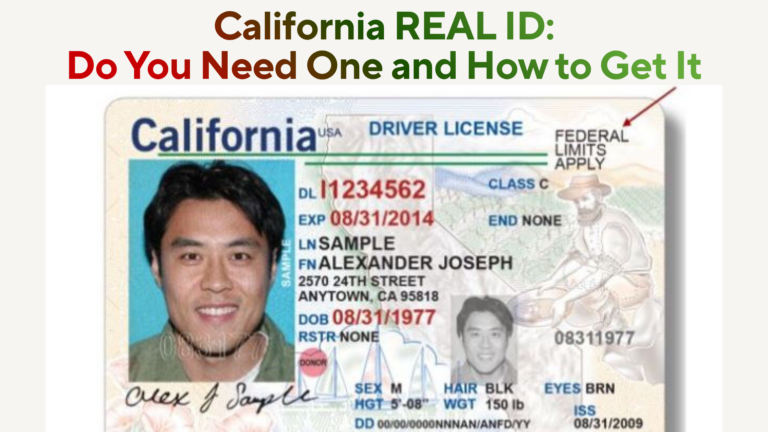
- Standard driver’s license. Lets you drive. Says “Federal Limits Apply” in the top right corner. Fine for driving, not accepted at airport security.
- REAL ID driver’s license. Same driving privileges, but marked with a golden bear and star, and accepted as federal identification. Covered in depth in our California REAL ID guide.
- ID card. No driving privileges. For people who need photo identification but don’t drive. Also comes in standard and REAL ID versions.
- AB 60 license. Available to applicants who can’t prove lawful presence. It works for driving. It cannot be a REAL ID, and applying for one makes you ineligible for a REAL ID card.
Your standard license expires on your fifth birthday after the application date. If your identity document expires sooner than that, you get a limited term license that expires when the document does.
Getting your first California driver’s license
The path splits by age.
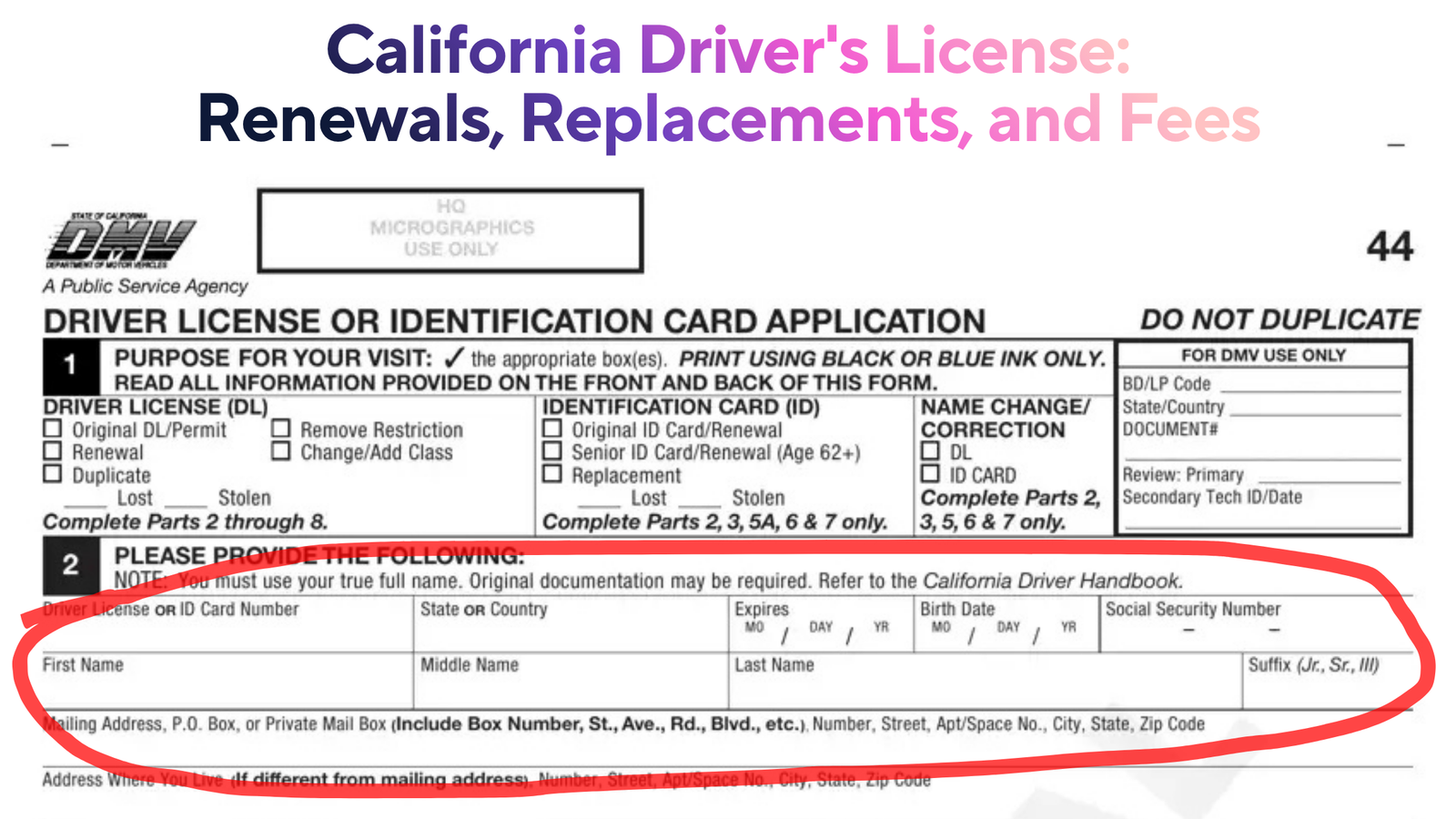
If you’re 18 or older, you complete the DL/ID application, visit an office, give a thumbprint, pass the vision exam, take your photo, pay the fee, and pass the knowledge test. Then you get an instruction permit, practice, and come back for the behind-the-wheel test.
If you’re under 18, add driver education and driver training certificates, a parent or guardian signature, and a provisional permit you have to hold for at least six months before the driving test. That six month clock is the part people forget, and it’s why starting early matters.
Your application and fee stay valid for 12 months, which trips people up. If you complete the online application and then wait more than six months to actually pick up your permit, the application can expire before you finish the six month holding period, and you pay again. You do get cumulative credit for permit time already served, so bring the expired permit along with the new one to your driving test.
The knowledge test gives you three attempts. Fail the same test three times and the application is dead, so you reapply and pay again. Offices also stop giving knowledge tests within 30 minutes of closing, which catches out people who show up at 4:45. Our written test guide covers what’s on it.
Renewing your driver’s license
The DMV mails a courtesy renewal notice about four months before your license expires. That notice tells you which renewal methods you’re eligible for, which you should read rather than assume.
Driving on an expired license is a citable offense, but there is no late fee for renewing one that already expired. The penalty is the ticket, not a DMV surcharge.
Renewing online
You can usually renew online if all of these are true:
- You’re within 90 days before, or 12 months after, the expiration date
- You don’t need to change your address or physical description
- You’re not applying for a REAL ID for the first time
- You’re not renewing a commercial license
No information can change during an online renewal. Not your address, date of birth, physical description, or license class. If something needs updating, that’s a different transaction. You can also register to vote during an online renewal.
Start at the DMV’s online renewal service.
Renewing by mail
Mail renewal has a stricter screen. You qualify only if you can answer no to every one of these:
- Does your license expire more than 120 days from today?
- Are you on any driving probation or suspension?
- Did you break a written promise to appear in court in the last two years?
- Have you already had two consecutive five year extensions by mail or internet?
- Do you hold a license from more than one state or jurisdiction?
- Are you applying for a REAL ID for the first time?
- Are you renewing a commercial license?
That fourth question is the one that eventually catches everyone. After two consecutive remote renewals, California makes you come in. If you qualify but never got a notice, file a DL 410 FO form. Send it with a check to:
Department of Motor Vehicles
ATTN: Renewal By Mail Unit
PO Box 942890
Sacramento, CA 94290-0001
Renewing in person
If your notice says to come in, bring the notice or a completed application, then expect to give a thumbprint, pass a vision exam, have your photo taken, pay the fee, and take a knowledge test if your notice says one is required.
You’ll leave with a temporary license good for 60 days. The real card arrives in three to four weeks. If nothing shows up after 60 days, check your DL/ID card status online. Booking ahead saves a lot of standing around, and our DMV appointment guide covers how.
If you’re 70 or older
Drivers 70 and up have historically renewed in person, but the DMV now lets most of that happen online, including starting the application and completing an eLearning course when one is required. Your renewal notice tells you whether you need a test. The DMV’s senior driver guide walks through the current process.
What it costs
Current figures from the DMV fee schedule:
| Transaction | Fee |
|---|---|
| Class C license, original or renewal | $46 |
| Adding a motorcycle license (M1 or M2) | $46 |
| Replacement license, lost or stolen | $37 |
| Changing information on your license | $37 |
| Behind-the-wheel retest | $9 |
| Regular ID card | $40 |
| Senior citizen ID card, age 62 and up | No fee |
| Reduced fee ID card | $11 |
| Commercial license, original | $100 |
| Commercial license, renewal | $59 |
Application fees are nonrefundable and stay valid for 12 months. Card payments carry a service fee, 1.95% online and at kiosks, 2.1% in an office. Paying by eCheck or bank account avoids it entirely, which matters most on the larger commercial transactions.
There’s no separate REAL ID surcharge in California. A REAL ID costs the same as the equivalent standard card.
Replacing a lost or stolen license
A replacement runs $37 and can often be done online through the DMV’s replacement service. You’re replacing the card, not changing anything on it. If you also need a name or address change, that’s a separate transaction and you should do that one instead.
If you lose your license before a flight, note that a temporary paper license is not accepted at airport security. You’ll need your passport instead.
Changing your name, address, or gender category
Address changes are free and can be done online. Name changes cost $37 and require a document proving the change, such as a marriage certificate or court order, because your card has to match your identity document exactly.
California gives you 10 days after a move to update the DMV, which is tighter than most people assume. If you’ve just moved, do it in the same sitting as the utilities and the mail forwarding. What usually happens instead is that the DMV slides to the bottom of the list while the next three weekends go to unpacking, sorting the garage, and pricing out garage organizers for a space that’s still full of boxes. Then the renewal notice goes to the old address and nobody sees it.
If you’re planning a REAL ID application and your name has changed since your birth certificate was issued, sort the name change documentation out first. Mismatched names are one of the most common reasons people get turned away.
ID cards
California issues three kinds. A regular ID card costs $40 and is valid for six birthdays. A senior citizen ID card is free for anyone 62 or older and lasts eight birthdays. A reduced fee ID card costs $11 for people who qualify through a participating program.
ID renewal by mail works if you can answer no to all three of these: have your last two cards been renewed remotely, has the card been expired more than a year, and are you changing or correcting your name. ID cards can also be renewed at a DMV kiosk, which is the fastest option if there’s one near you. You’ll need your name, the address on file, your birth date, and your card number.
Special cases
Adding a motorcycle license (M1 or M2) to an existing Class C costs $46 and requires its own knowledge test.
Commercial licenses work differently in a few ways. A CDL expired more than two years requires a full skills test to get back, renewal costs $59, and you provide a residency document at every renewal rather than just the first.
There’s also an active freeze worth flagging: the DMV currently cannot issue, reissue, or renew limited term legal presence (non-domiciled) commercial licenses. If that’s your situation, contact the DMV directly rather than starting an application that won’t process.
The vision standard
You need at least 20/40 with both eyes tested together, and at least 20/70 in your weaker eye. Corrective lenses count, so bring your glasses.
People rarely think to report this one: if you had vision surgery that corrected one eye for distance and the other for close-up, you may not meet the screening standard and will need to renew in person. Temporary conditions like a broken bone or pregnancy don’t need reporting. A new disability that affects your ability to drive safely does, and may mean a behind-the-wheel test.
Frequently asked questions
How often does a California license expire?
Every five years, on your birthday.
Can I drive while my license is expired?
No. You can be cited for it. There’s no late fee to renew, but there’s nothing stopping a ticket either.
Can I change my address while renewing online?
No. Online renewals can’t change any printed information. Handle the address change separately, or renew by mail with the corrected address written on the notice.
How long until my new card arrives?
Three to four weeks. Your temporary license covers 60 days. If nothing has arrived by then, check your status online.
How many tries do I get on the knowledge test?
Three per test. Fail the same one three times and you reapply and pay again.
Do I need to take a test to renew?
Usually not. Your renewal notice tells you if you do.