What Hunters Need to Know About CWD: Crucial Updates for the Season
As conservationists and stewards of the land, hunters have always stood on the front lines of wildlife management. Today, our deer, elk, and moose herds face a formidable, creeping threat: Chronic Wasting Disease (CWD). Often referred to in mainstream media as “zombie deer disease,” CWD is far from a sci-fi plotline—it is a critical, slow-moving ecological challenge that demands our attention, cooperation, and proactive action.
With wildlife agencies across North America rolling out sweeping regulatory overhauls, mandatory testing zones, and carcass transport bans, staying informed is no longer optional. It is a vital component of a successful, ethical hunt. Even your selection of hunting gear—from your rifle and choice of caliber down to your optics—plays a subtle role in how we navigate and adapt to a CWD-altered landscape. Here is everything hunters need to know about the current state of CWD, recent regulatory updates, and how you can help protect the future of hunting.
What is CWD? The Science Behind the Threat
To effectively combat CWD, we must first understand what it is. Unlike traditional wildlife diseases caused by bacteria or viruses, CWD is a transmissible spongiform encephalopathy (TSE)—a family of progressive, neurodegenerative disorders caused by prions.
Prions are not living organisms; they are misfolded, mutated proteins. When a healthy animal comes into contact with these prions, it triggers normal proteins in their brain and nervous system to misfold as well. This creates a cascade effect, leaving microscopic holes in the animal’s brain tissue.
Key Biological Realities Hunters Must Know:
- The Long Incubation: An infected deer, elk, or moose can take anywhere from 12 months to over two years to show any physical symptoms. During this time, they appear completely healthy, vibrant, and muscular—yet they are actively shedding infectious prions into the environment.
- The Symptoms: In its terminal stages, CWD causes drastic weight loss (emaciation), stumbling, tremors, excessive drooling, drooping ears, and a complete loss of fear toward humans. Once symptoms manifest, the disease is invariably fatal.
- Environmental Longevity: Prions are shed through saliva, urine, feces, blood, and decaying carcasses. What makes them terrifyingly persistent is that they bind tightly to soil and vegetation and can remain infectious in the environment for years, resisting extreme heat, freezing temperatures, and traditional disinfectants.
Crucial Geographic Updates: Where is CWD Now?
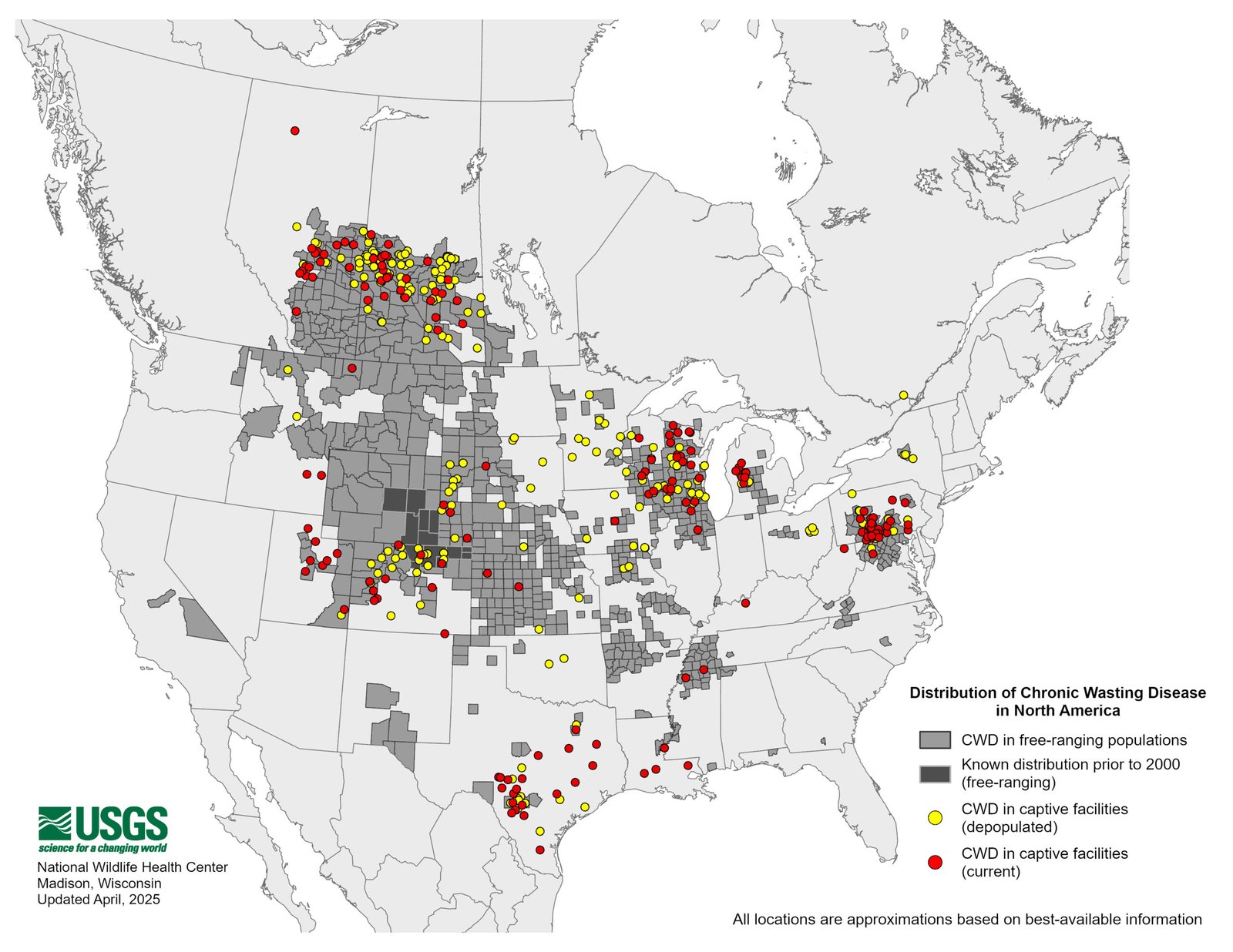
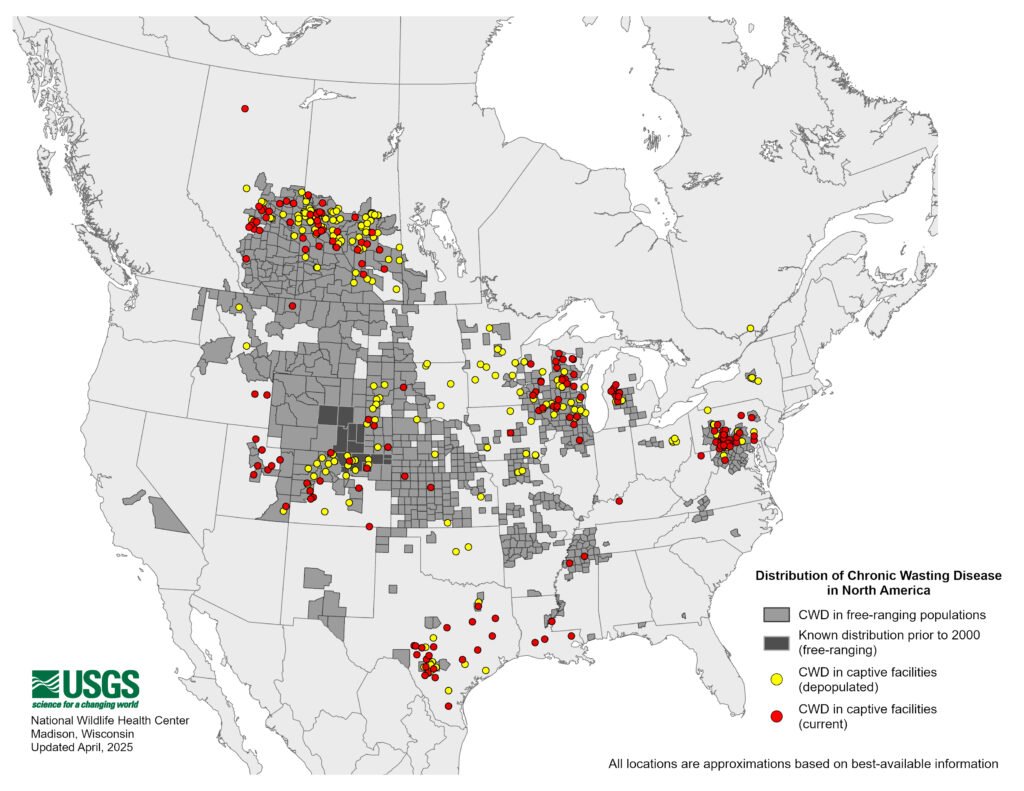
The geographic footprint of CWD continues to expand at an alarming pace. It has now been detected in free-ranging or captive cervid populations across 37 U.S. states and 5 Canadian provinces.
Recent updates highlight just how rapidly the map is shifting:
- New Frontiers: States traditionally considered “safe” have recently joined the positive list. Delaware officially became the 37th state to detect CWD. This follows major first-time detections on the West Coast and Southeast, including California, Washington, Indiana, and Georgia.
- High-Prevalence Zones: In long-established endemic regions—such as parts of Wyoming, Colorado, and Wisconsin—prevalence rates can exceed 40% in free-ranging herds. Biologists have formally documented measurable population declines in these heavily impacted herds.
Gear and Tactics: How CWD Impacts Your Setup
While CWD is a biological crisis, it has practical implications for the hardware you carry into the woods. The reality of hunting in CWD management zones means maximizing efficiency and absolute target identification.
1. Precision Rifles and Dropping Game Cleanly
When hunting in an area with a high prevalence of CWD, it is more critical than ever to anchor game quickly. An animal that runs a long distance after the shot can bleed out across a wider radius or die in an inaccessible spot, leaving the carcass to scavenge or decay on the landscape, potentially spreading prions to the soil.
- Many hunters in CWD zones are moving toward incredibly accurate bolt-action or high-end precision rifles chambered in highly efficient, flat-shooting cartridges like the 6.5 Creedmoor, .308 Winchester, or 7mm PRC. The priority is hard-hitting, reliable accuracy.
2. Optics and Scopes: The Vital Role of Identification
A premium rifle scope is no longer just about making a clean shot—it is your primary tool for evaluating the health of the animal from a distance.
- High-magnification riflescopes (such as a 3-18x or 4-16x optic) featuring superior light transmission and clear glass allow you to observe a deer’s behavior before pulling the trigger.
- Use your optics to look for early warning red flags: Is the animal stumbling? Does it display listless or unusually bold behavior near roads? Is there visible emaciation or excessive drooling? Identifying these signs through your scope before taking a shot lets you report a sick animal to local game wardens rather than harvesting and handling a highly infectious carcass.
Regulatory Overhauls: What Changes for the Hunting Season?
State and provincial wildlife agencies are modifying their hunting frameworks to slow the transmission of prions. Hunters must carefully review local regulations before heading into the field, paying special attention to the following three pillars:
1. Mandatory vs. Voluntary Sampling
Depending on where you hunt, submitting your harvest’s head or lymph nodes for testing may be a legal requirement. In newly affected states like California, specific hunting zones have instituted strict mandatory sampling for all harvested deer. Failing to submit a sample can result in heavy fines and tag revocation.
2. Strict Carcass Transport Restrictions
The fastest way CWD spreads across vast distances is not by migrating deer, but by humans transporting infected carcasses in the beds of pickup trucks. To prevent this, nearly every state now enforces strict carcass movement laws.
- The Golden Rule: It is widely illegal to transport a whole deer or elk carcass out of a designated CWD Management Zone or across state/provincial lines.
- What You Can Move: Generally, you are only allowed to transport boned-out meat, commercially processed cuts, caped hides (with no head tissue attached), finished taxidermy, and clean skull plates/antlers with all brain and soft tissue completely removed.
Human Health and Gear Maintenance: Best Practices
To date, there has been no documented case of CWD infecting a human. However, the Centers for Disease Control and Prevention (CDC) strongly advise a cautious approach. If you harvest an animal in a known CWD area, do not consume the meat until you receive a “Not Detected” test result.
Beyond your kitchen, CWD requires a strict decontamination protocol for your field-dressing and processing gear:
1.Mechanical Cleaning:Immediately post-harvest.
Put on nitrile gloves. Use soap, water, and a stiff brush to scrub all visible meat, hair, and organic tissue off your field knives, bone saws, and processing surfaces. Prions bind tightly to stainless steel, and organic matter can shield them from disinfectants.
2.Prepare the Bleach Solution:40% Concentration.
Mix a potent solution of 2 parts household bleach to 3 parts water (yielding roughly a 40% bleach solution). Standard, weak household cleaners will not neutralize prions.
3.Submerge and Soak:5 to 10 Minutes.
Completely submerge the stainless steel blades of your field knives and bone saws in the 40% bleach solution. Let them soak for a minimum of 5 to 10 minutes.
4.Rinse and Oil:Gear Protection.
Remove your tools from the bleach solution and rinse them thoroughly with clean water. Because bleach is highly corrosive to metal, dry your knives immediately and apply a light coat of food-safe mineral oil to protect the steel blade.
Conclusion
Chronic Wasting Disease is a generational challenge to the hunting community. However, this does not mean the end of our hunting heritage. It simply means that our definition of a successful hunter has evolved.
A successful hunter is no longer just someone who dials in their rifle scope, makes an ethical shot, and fills the freezer. It is someone who knows the regulations, submits samples to drop-off stations, respects carcass transport boundaries, and actively sanitizes their gear. By staying educated and participating in surveillance, we ensure that our rich hunting traditions endure for generations to come.