Do Electric Bikes Need to Be Registered? A Complete Guide to eBike Registration Laws
The explosive rise of electric bikes (eBikes) has transformed how we commute, exercise, and explore our cities. But as eBikes blend the line between human-powered bicycles and motorized vehicles, they’ve left many riders asking a crucial question: Do electric bikes need to be registered?
The short answer is: in most places, no—but it entirely depends on how powerful your eBike is and where you live.
Because laws vary drastically across states, countries, and local municipalities, treating an eBike like a regular bicycle in one town could technically land you a ticket in another. Governments look at specific factors like motor power, top speed, and throttle capabilities to draw the line between a bicycle and a moped.
Here is everything you need to know about navigating eBike registration laws to ensure your next ride is completely legal.
Do Electric Bikes Need to Be Registered?
In Most States, Standard eBikes Do Not Require Registration
If you own a standard, commercially built electric bike, you are likely in the clear. In the vast majority of U.S. states and European countries, standard eBikes do not require vehicle registration, license plates, or special DMV permits.
Governments generally classify these eBikes closer to traditional bicycles rather than motor vehicles. The rationale is simple: they travel at modest speeds, utilize bicycle infrastructure (like bike lanes), and still require physical pedaling or user control that mirrors traditional cycling. Because they don’t pose the same safety risks to the public as heavy, high-speed motorcycles, they escape the red tape of the DMV.
When Might an eBike Need Registration?
While standard eBikes get a pass, your eBike might require formal registration if it crosses into “motor vehicle” territory. Here are the most common scenarios where registration becomes mandatory:
- High-Powered Motors: Eikes with motors exceeding standard limits (usually greater than 750 Watts in the U.S. or greater than 250 Watts in Europe).
- Excessive Speeds: Any electric street bike that can exceed 28 mph under motor power alone or via pedal assist.
- Out-of-the-Box Modifications: If you modify your eBike’s software or motor to bypass factory speed limiters, it legally ceases to be an eBike.
- Moped Classification: Certain heavy-duty electric bikes feature heavy frames and functional throttles that push them into the legal definition of a moped or motorized scooter, requiring a license plate.
eBike Classification and How It Affects Registration
To keep laws uniform, 40+ U.S. states have adopted a strict three-class system for eBikes. Knowing which class your bike falls into is the easiest way to determine if you need to register it.
| Classification | How the Motor Works | Max Assisted Speed | Is DMV Registration Required? |
| Class 1 | Pedal-Assist Only: Motor only engages when you are actively pedaling. | 20 mph | No |
| Class 2 | Throttle-Assisted: Can propel the bike using a throttle without pedaling at all. | 20 mph | No |
| Class 3 | Speed Pedal-Assist: Motor assists only when pedaling, but handles higher speeds. | 28 mph | No (In almost all states) |
| Out-of-Class / Moped | Throttle or Pedal-Assist: Motor power exceeds 750W (U.S.) or 250W (Europe). | Over 28 mph | Yes (Likely required) |
Class 1 Electric Bikes
Class 1 eBikes are pedal-assist only, meaning the motor only kicks in when you are actively pedaling. The motor stops assisting once you reach 20 mph. Because their speed mimics a fast traditional cyclist, Class 1 eBikes are universally treated like standard bicycles and never require registration.
Class 2 Electric Bikes
Class 2 eBikes feature a throttle, allowing you to propel the bike forward without pedaling at all (much like a scooter). However, like Class 1, the motor cuts off at 20 mph. In almost all jurisdictions following the class system, Class 2 eBikes do not require registration, though they face slightly stricter rules regarding where they can be ridden (e.g., some natural mountain bike trails ban them).
Class 3 Electric Bikes
Class 3 eBikes are high-speed pedal-assist bikes that provide motorized help all the way up to 28 mph, and they are legally required to have a speedometer. Because of their higher speeds, Class 3 bikes occupy a legal gray area. While they generally do not require DMV registration, they are subject to strict operational laws. Many areas enforce a minimum rider age (usually 16), mandatory helmet laws regardless of age, and strict bans from dedicated multi-use bike paths.
Electric Bike Registration Requirements by State
States Where eBike Registration Is Usually Not Required
States that strictly enforce the three-class system—such as California, New York, Texas, Florida, and Colorado—do not require registration for Class 1, 2, or 3 eBikes. If your bike has a manufacturer label indicating its class, power output, and top speed, your only job is to follow local equipment laws (like having working front lights) and wear a helmet if required.
States With Additional eBike Rules
Not every state aligns perfectly with the three-class framework. Some states have older, more ambiguous laws on the books that can trip riders up:
- Hawaii: Hawaii does not use the three-class system. Instead, eBikes must be registered with the state for a one-time fee of $30, and riders must be at least 15 years old.
- Massachusetts & New Jersey: These states have historically drawn stricter lines regarding throttles or higher speeds, occasionally classifying certain eBikes as “motorized bicycles” that require a specialized moped license or registration.
- Labeling Laws: Many states now legally require manufacturers to affix a permanent, highly visible label to the frame indicating the eBike’s exact class, top speed, and motor wattage. If your bike lacks this label, local law enforcement might assume it’s an illegal motorized vehicle.
Always check your specific state’s Department of Transportation (DOT) or DMV website, as municipal city parks can overlay their own hyper-local restrictions.
What Documents Do You Need to Register an eBike? (If Required)
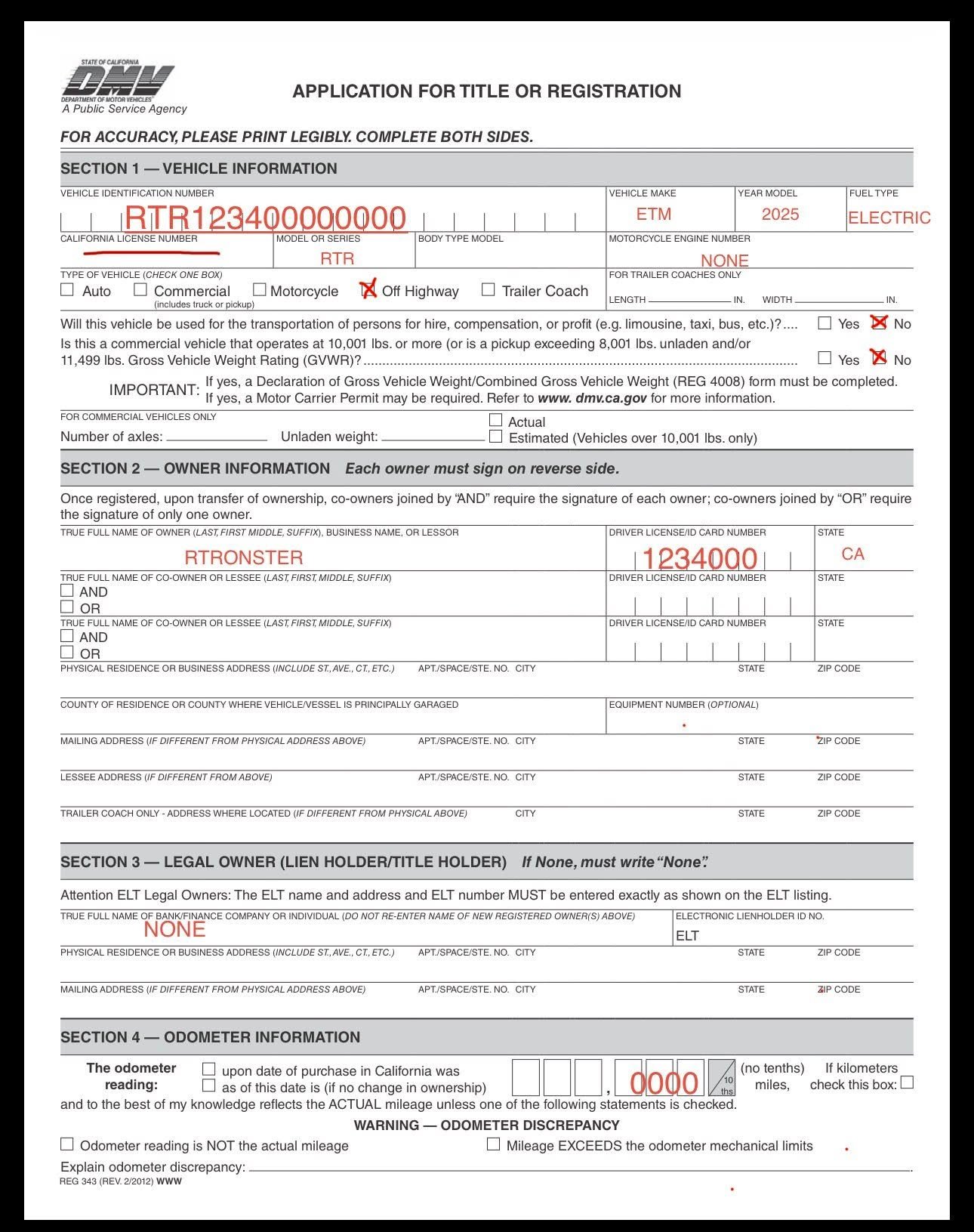
If you happen to live in a region that requires registration, or if your bike is a high-powered model (like a Sur-Ron or Onyx) that crosses into moped territory, you’ll need to gather paperwork before heading to the DMV.
Common Registration Requirements
- Proof of Ownership: A formal bill of sale or the original manufacturer’s invoice.
- Purchase Receipt: Proof that sales tax was paid (or you may have to pay it at the DMV).
- Manufacturer Information: The user manual indicating the motor wattage, top speed, and frame type.
- Serial Number or VIN: Just like cars, eBikes have a unique serial number stamped under the bottom bracket (between the pedals) or on the headtube.
- Personal Identification: A valid state ID or driver’s license.
Registration Fees and Renewal
Registration costs for eBikes are typically incredibly low compared to cars. They usually range from a one-time fee of $10 to $30, or a nominal annual renewal fee.
Do Electric Bikes Need Insurance or a License?
Are eBike Licenses Required?
For standard Class 1, 2, and 3 eBikes, no driver’s license or motorcycle endorsement is required. You can be twelve years old or have a suspended driver’s license, and you can still legally ride a standard eBike in most states.
The exception strictly applies to “out-of-class” electric vehicles. If your bike goes over 28 mph or has a motor larger than 750W, it may be legally deemed a moped or motorcycle, meaning you will need a valid driver’s license to operate it on public roads.
Do You Need eBike Insurance?
While insurance is not legally mandated for standard eBikes, getting a specialized policy is highly recommended.
Traditional auto insurance won’t cover an eBike, and standard homeowners or renters insurance often features explicit exclusions for “motorized vehicles” if your eBike is stolen outside your home. Dedicated eBike insurance is highly affordable and provides invaluable coverage for:
- Theft Protection: eBikes are prime targets for thieves.
- Liability Coverage: Protects you financially if you accidentally strike a pedestrian or cause property damage.
- Medical Payments: Covers your medical bills if you are injured in an accident.
How to Check if Your Electric Bike Needs Registration
Unsure where your setup stands? Follow this quick two-step checklist:
1. Check Your Local eBike Laws
Look up your state’s DMV or Department of Transportation website. Search specifically for “electric bicycle laws” rather than general motorcycle laws. Furthermore, check your local city or town ordinances, as local park boards have the right to ban even unregistered eBikes from specific paved paths or trail networks.
2. Check Your eBike Specifications
Look closely at your bike’s hardware. You need to know:
- Motor Wattage: Is it 750W or less? (In Europe, is it 250W or less?)
- Max Assisted Speed: Does the motor stop pushing at 20 mph or 28 mph?
- Throttle Capability: Can the bike move without you pedaling?
- Manufacturer Label: Look for a sticker near the crank arm or on the downtube confirming its Class 1, 2, or 3 status.
Common Questions About eBike Registration
Do I Need to Register an Electric Bike Bought Online?
Buying an eBike online from a direct-to-consumer brand does not automatically trigger a registration requirement. What matters is the bike’s design specs, not where you bought it. If the online bike complies with your state’s Class 1, 2, or 3 definitions, no registration is needed.
Do Fat Tire Electric Bikes Need Registration?
No. Tire width has absolutely no bearing on registration laws. A fat-tire eBike designed for snow or sand is subject to the exact same wattage and speed laws as a skinny-tired commuter eBike.
Do Electric Trikes Need Registration?
Generally, no. Most electric tricycles are designed for stability and utility, usually falling comfortably into Class 1 or Class 2 specifications. However, always check local definitions, as a few jurisdictions explicitly define a bicycle as having “two wheels,” which can trigger unique structural loopholes for trikes.
Can I Ride an Unregistered eBike?
If your eBike falls within standard classes, yes! However, if you are riding an unregistered high-powered electric bike that legally qualifies as a moped or motorcycle, you risk getting your bike impounded, receiving heavy fines, or being cited for operating an unregistered motor vehicle.
Conclusion: Check Local Laws Before Riding
For the vast majority of riders, electric bikes offer all the joy and freedom of open-air transit without any of the DMV headaches. If your eBike tops out at 20 or 28 mph and stays under 750 watts, you can safely skip the registration lines and hit the bike lanes.
However, because the legal landscape surrounding eBikes is evolving rapidly, always take five minutes to review your local state and city guidelines. Knowing your eBike’s exact classification and staying compliant won’t just keep you on the right side of the law—it ensures our paths and roads stay safe for everyone.